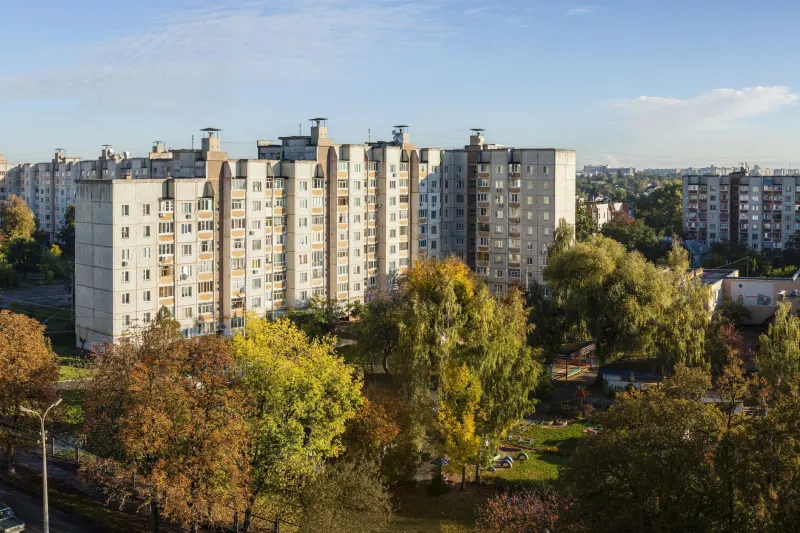
What Your Eyes Are Telling Your Brain: The Science of Sightlines in Mid-Rise Urban Homes
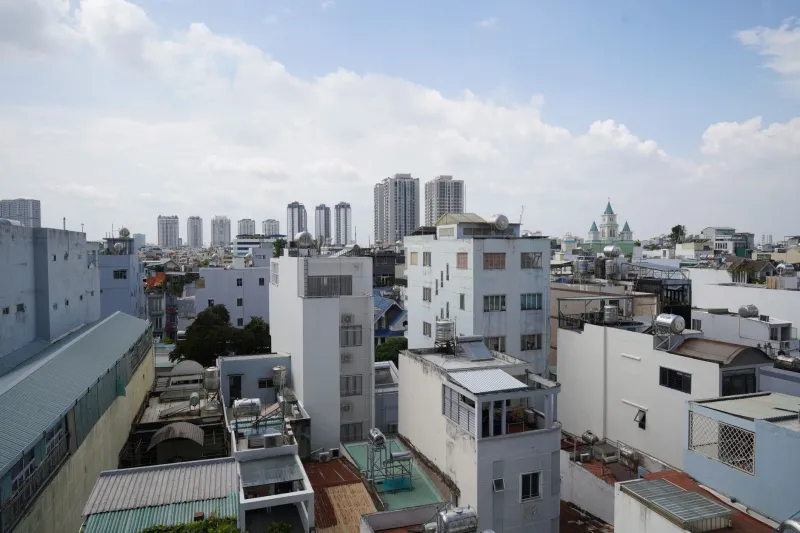
Most homebuyers evaluate a view the way they evaluate a painting — aesthetically, instinctively, and briefly. They glance out the window during a showing, note whether it's pleasant or not, and move on to square footage and countertop finishes. What rarely enters the conversation is what that view is actually doing to the person standing in front of it.
The answer, according to decades of research in environmental psychology, is quite a lot.
At Gowra Urban Winds, the architecture of visual openness is not incidental to the residential experience — it is central to it. The placement of homes within natural wind corridors creates something that dense urban construction almost never delivers: the ability to see across a cityscape rather than directly into it.
The Neuroscience of the Horizon
Human vision evolved over hundreds of thousands of years in open landscapes. The eyes and brain developed a sophisticated relationship with distance — the ability to scan far, to assess space, to locate oneself within a broader environment. Neurologically, this capacity for what researchers call "prospect" — the ability to perceive an expansive view — is deeply tied to feelings of safety and cognitive ease.
Roger Ulrich, whose landmark research at the University of Delaware and later Texas A&M University demonstrated measurable physiological changes in subjects exposed to natural or open views, found that even brief visual access to expansive scenes reduced sympathetic nervous system activity. In plain terms: wide sightlines calm the body's stress response in ways that enclosed or obstructed views do not.
When your window looks directly into another building's facade — a reality for millions of urban apartment dwellers — your visual system registers enclosure. The brain interprets this as confinement. Cortisol levels, the body's primary stress hormone, tend to remain elevated in environments that limit visual range, even when the resident is otherwise comfortable.
Conversely, a view that extends across rooftops, open sky, or a wind-cleared urban corridor signals spatial abundance. The brain reads distance as freedom, and freedom as safety.
Perceived Space vs. Actual Space
Here is where sightlines become a genuine design consideration rather than a luxury amenity: the perceived size of a living space is substantially influenced by what can be seen beyond its walls.
Environmental psychologists use the term "borrowed space" to describe the psychological square footage that an occupant gains through visual access to an exterior environment. A 900-square-foot apartment with an unobstructed view of open sky and distant cityscape will reliably feel more spacious than a 1,100-square-foot unit whose windows face a neighboring wall three meters away.
This is not a subjective impression. Studies measuring perceived room size consistently find that exterior visual access — particularly when that access extends to a mid-distance or far horizon — inflates the occupant's estimate of interior space by a statistically significant margin. Architects working in high-density urban environments have long understood this principle; it is why corner units with dual-exposure windows command premium pricing in virtually every American city.
Mid-rise positioning within a wind corridor amplifies this effect. Because the surrounding built environment is lower and less obstructive, and because the corridors themselves preserve lateral visual access rather than funneling it vertically, residents experience a panoramic quality that high-rise towers — paradoxically — often fail to deliver. A tower resident at the fortieth floor may see far, but they see downward. A mid-rise resident sees across, which is precisely the visual geometry the human nervous system finds most rewarding.
Creativity, Focus, and the Open View
The implications extend well beyond stress reduction. Research published in the Journal of Environmental Psychology has examined the relationship between visual openness and divergent thinking — the cognitive mode associated with creativity and problem-solving. Subjects who completed creative tasks in environments with expansive visual access consistently outperformed those in visually enclosed spaces.
The proposed mechanism involves attentional restoration theory, developed by Rachel and Stephen Kaplan at the University of Michigan. Their framework holds that natural or spatially open environments allow the directed attention system — the cognitively effortful focus we use for work and decision-making — to rest and recover. The view from a window that reaches the sky or an open urban corridor provides what the Kaplans called "fascination without demand": visual engagement that does not require cognitive effort, allowing the prefrontal cortex to recover from sustained concentration.
For the growing population of Americans working remotely from home — a demographic that has permanently reshaped residential priorities since 2020 — this has practical consequences. A home that provides regular visual access to open sightlines is not merely more pleasant; it is functionally more supportive of the cognitive demands of knowledge work.
The Social Dimension of Visual Openness
There is a subtler dimension to this conversation that rarely surfaces in real estate marketing: the relationship between sightline quality and social confidence.
Psychologists studying urban environments have found that residents of visually enclosed spaces — those who live behind obstructed windows or in units that face internal courtyards and adjacent walls — report higher rates of social withdrawal and lower neighborhood attachment than those with open exterior views. The proposed explanation is partly territorial: visual access to a wider environment creates a sense of belonging to that environment, of being a participant in the city rather than a spectator behind glass.
Residents who can see the skyline, track the weather, observe the rhythm of the streets below from a comfortable mid-rise elevation, develop what researchers describe as a stronger sense of "place identity" — a feeling of being genuinely located in their city rather than merely housed within it.
This matters for community formation. Homeowners who feel connected to their broader environment tend to invest more in it — socially, civically, and financially. The view, in other words, is not just a personal amenity. It is an infrastructure for belonging.
Measuring What Markets Miss
Real estate appraisals in the United States have historically struggled to quantify the view premium with precision. The conventional approach assigns a rough percentage adjustment based on whether a unit has a water view, a park view, or a city view — categories that capture geography but not the neurological quality of what is actually visible.
What the standard appraisal framework does not measure is sightline depth, visual continuity, or the degree to which a view supports the psychological functions described above. A unit that overlooks a narrow urban alley and a unit that overlooks a wind corridor offering half a mile of unobstructed visual range may both be classified as having a "city view" for appraisal purposes. The lived experience, and the neurological benefit, are not remotely equivalent.
At Gowra Urban Winds, the design philosophy takes seriously what the market has been slow to price. The orientation of residences within the wind corridor is not accidental — it is a deliberate alignment of architectural placement with the documented psychological needs of the people who will live there. The sky you can see from your living room is not decorative. It is, in a measurable and meaningful sense, part of the home itself.
When modern living meets the open sky, it is not simply a tagline. It is a description of what the research says your brain has been looking for all along.